Monday, July 30, 2012

DRIVING IN THE DARK


I came across this quote today:

"Writing a novel is like driving a car at night. You can see only as far as your headlights, but you can make the whole trip that way."
E.L. Doctorow

It perfectly describes my writing process at the moment. I thought I had a plan, instead I'm finding I have a destination and I'm driving there in the dark. And I have to say that the full-beam function on my literary car is behaving erratically. 

I'm moving along - well under the speed limit - from scene to scene. Every hill and corner discovered moments before I approach them.

Is it scary? You betcha!

Am I enjoying myself? Yes!

How's your writing going at the moment?

Friday, July 27, 2012

SILENT IN THE SANCTUARY BY DEANNA RAYBOURN

I think I've all ready mentioned that lately I've been drawn to historical mysteries. It's a new genre for me and I really am enjoying myself. I have two new Lady Emily novels by Tasha Alexander and the second Flavia de Luce by Alan Bradley on my shelves, thanks to a recent birthday. I'll tell you more about those as I finish them.

Recently I discovered another author: Deanna Raybourn and her Lady Julia books.  I found this at a second hand bookstore. It was the cover that drew me first.


Isn't it striking?

This is the second lady Julia book, but it's a stand alone.  Here's the blurb from the back cover:

Fresh from a six-month sojourn in Italy, Lady Julia returns home to Sussex to find her father's estate crowded with family and friends - but dark deeds are afoot at the deconsecrated abbey, and a murderer roams the ancient cloisters.

This had me hooked from the first page. Her writing is superb. I found myself reading out sentences to my family, just for the sheer enjoyment of hearing them. Here's an example:

I was alone with the slow ticking of the mantel clock and the crisp, rustling taffeta sounds of the fire as it burned down to ash.

Her characters are quirky, yet well defined and the mystery had enough twists and turns to keep me guessing. Strangely it took me awhile to read this book. It is hefty at over 400 pages, but I enjoyed every minute of them.

I forgot to mention, it is set in the 1880s - a favourite decade of mine for both reading and writing!

I'll certainly be reading more Lady Julia novels.

Wednesday, July 25, 2012

AND THE ANSWER IS ...

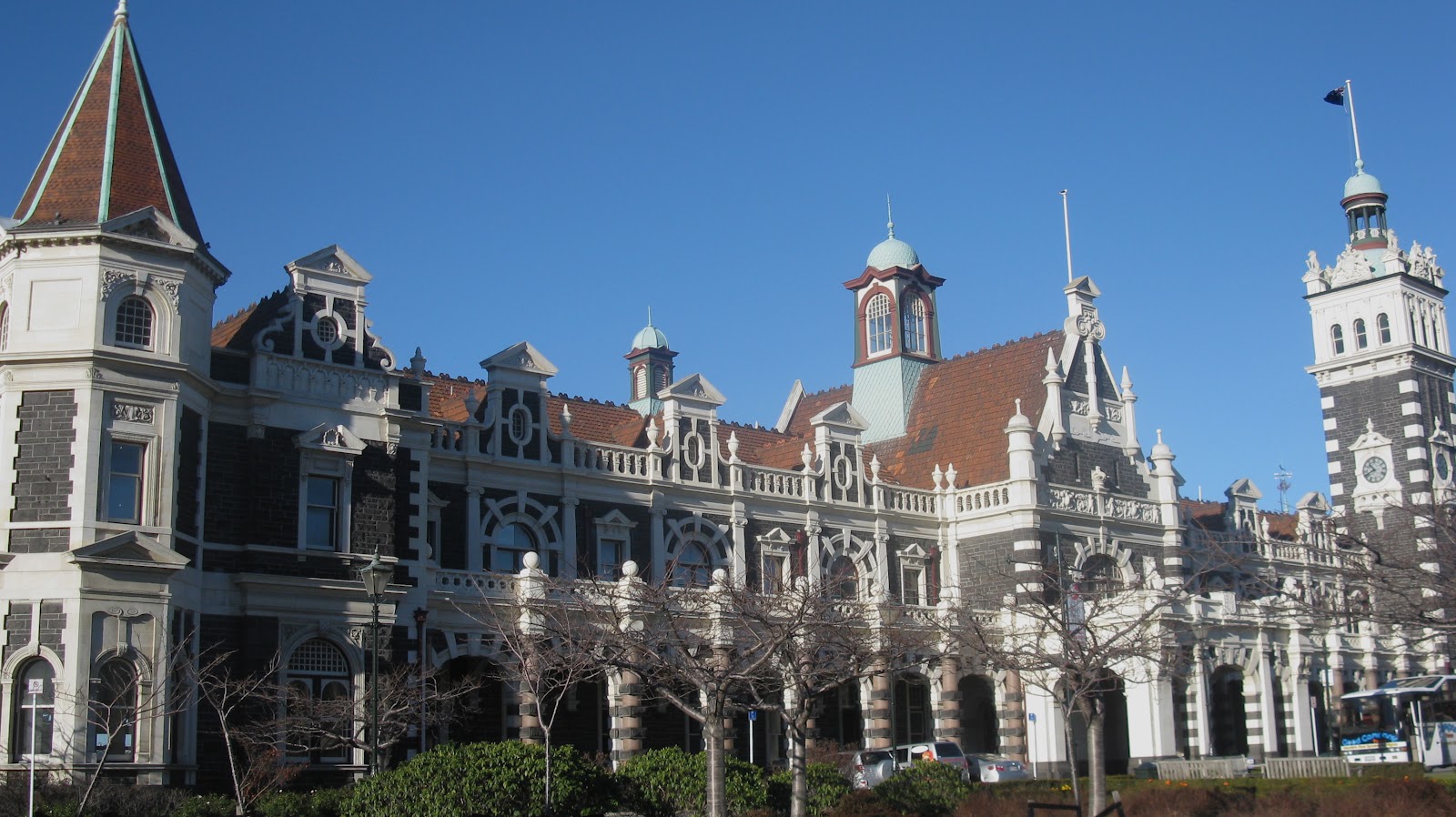
Congrats to Kura for guessing correctly. The photo in my last post was taken inside the Dunedin Railway Station.


I've been snooping around town for old buildings that would've been here in the time of Amelia's novel - set in the 1880s. Alas the Railway Station is Edwardian rather than Victorian, but as it's my favourite building in Dunedin it deserves a post all of its own.

It's only in recent years that it has come to my attention. I think it was a case of growing up with it and really not noticing what a gorgeous building it is. And in the last couple of years, with the destruction of so many precious buildings in the Christchurch earthquakes I started to look at my city in quite a different light. I remember in the days following the February quake, when we were all reeling from the tragic loss of life, every trip through town had me gazing at all our old buildings and trying to imagine them turned to rubble. It was a sobering exercise.

Construction on the station began in 1903 and was completed in 1906, giving Dunedin its fourth station building. (So far I've been unable to unearth photos of the earlier stations.) Back then it was the busiest  in New Zealand with up to 100 trains passing through per day. Which seems a staggering amount considering that these days we only have freight trains and tourists runs.

The architect was George Troup and his elaborate design, using dark basalt and white Oamaru stone, earned him the nickname "Gingerbread George".


The main entrance.


These days the station is not only used for trains. The Otago Art Society and the Sports Hall of Fame are situated on the first floor, the Otago Farmers market is held every Saturday morning, using part of the platform and a car park and every year the ID Fashion parade turns the platform into a cat walk.

The longest railway platform in New Zealand.


But it's not just the exterior that is beautiful. The inside is an absolute treat. Mosaic tiled floors, stained windows and an intricately worked balcony.


The mosaic floor of the main foyer, taken from the balcony.


I hope you've enjoyed your tour of Dunedin's Railway Station.

Now it's back to the writing for me.  Amelia's been left in a rather awkward situation and I'm looking forward to seeing how she extricates herself.

Monday, July 23, 2012

IT"S MONDAY!

Another new week begins. This time without sick kids or sick me ... please?

Well, its almost lunchtime on Monday and I have written several pages all ready. Today's a good day, long may it last.

I'm enjoying the process of Amelia's novel immensely. Little surprises at every turn. It seems so long since I've been writing like this. Having that vague idea about where things are going, then page by page the story crystalizes. Characters say and do things without even asking my permission! New characters turn up without invites! And then the character you thought you knew, felt sure you could rely, does something so out of character it sends your head reeling.

Who said being locked in a garrett (well, a room really) with pen and paper (ok, it's a Mac) was boring?

When I come up for air I've got a post planned, featuring the most photographed building in the Southern Hemisphere.

Here's a wee clue.  Any ideas?

This is a picture from the interior.


Friday, July 20, 2012

NO PEEKING. WE'RE CHANGING.

Dunedin is blessed with two museums. The Otago Museum, which is located at the north end of town, focuses on natural history, science, early civilizations and Maori heritage. There is an Egyptian mummy, the skeleton of a whale and a fine display of ceramics through the ages. One of my favourite displays is the Victorian Animal Attic, which has just been refurbished.


The oldest section of The Otago Settlers Museum


But it's Dunedin's other museum that I want to talk about. The Otago Settlers Museum. The focus of this museum was originally the settling of Otago which began with the arrival of the John Wickliffe on 23rd March 1848. Wickliffe's sister ship, the Philip Laing arrived three weeks later
In recent years the museum has enlarged its scope to include the Maori people and has extended its coverage back to 1770: the year captain Cook first arrived in southern New Zealand. 


A sponsor sign on a path, in front of our railway station, from a local company named after the first ship.


Displays include a dormitory-like ship's cabin that rolls as if on the high seas, a room with floor to ceiling portraits of Dunedin's settlers, an old steam train named Josephine and many examples of early life, both domestic and at work.


As you can imagine, with my love of history, this is a place I love to haunt. However it is undergoing huge refurbishments which forced a temporary closure. Sometime later this year it will open - bigger and better than before. And yes, I can't wait! In the meantime my eye is always caught by a couple of large posters whenever I pass by. It was these posters that drew me the other day to go walking with my camera ...


The museum also inhabits an old art-deco bus station.


As a child I remember the railways buses driving in at one end of this building then driving out the other. Lately it has been housing an historic transport display.


There's a whole new section being added as well as all the work inside the original buildings.


When it opens again I'll tell you all about it.